
TECHDADA
We will choose best phone for you


SMARTPHONES
We Provide Honest Reviews

ONE PLUS 6
First off, there's a notch. The 5T brought a tall 18:9 display, the 6 takes it to the next level with a 19:9 aspect and a cutout up top for the classic phone bits. It's still AMOLED ('Optic AMOLED' OnePlus calls it), and it's still 1080px on the short side, but this time 120px more on the long end - subtracting those gone under the notch, of course.
A major design change sees the back now made of glass, but sadly no wireless charging has come with that, for those that care. There's no explicit IP rating either, though official materials and teardowns have mentioned some waterproofing measures.
The secondary camera on the back is the same and it hasn't magically started making sense to us a few months into the 5T's existence. The good news is the primary module has been upgraded - a detail you could easily miss seeing the same pixel count. The 16MP sensor is now bigger (1/2.6" vs. 1/2.8") and the bright f/1.7 aperture lens is stabilized - we'll go with 'kudos, OnePlus' instead of 'about time' since we're positive like that.
Specification
Body: Aluminum frame, glass back, 2.5D Gorilla Glass 5 display glass. Mirror Black, Midnight Black, Silk White color schemes.
Display: 6.28" Optic AMOLED, 2,280x1,080px resolution, 19:9 aspect ratio, 402ppi; sRGB/DCI-P3 color space support.
Rear cameras: Main camera: Sony IMX519 1/2.6" sensor, 16MP, 1.22µm pixel size, f/1.7 aperture, phase detection autofocus, OIS, EIS. Secondary camera: Sony IMX376K sensor, 20MP, 1.0µm pixel size, f/1.7 aperture. 2160p/60fps video recording, 1080p/240fps or 720p/480fps slow motion
Front camera: Sony IMX371 sensor, 16MP, 1.0µm pixel size, f/2.0 aperture; 1080p/30fps video recording.
OS/Software: Android 8.1 Oreo; OxygenOS custom overlay.
Chipset: Qualcomm Snapdragon 845: octa-core CPU (4x2.7 GHz Kryo 385 Gold & 4x1.7 GHz Kryo 385 Silver), Adreno 630 GPU.
Memory: 6/8GB of LPDDR4X RAM; 64/128/256GB UFS 2.1 storage.
Battery: 3,300mAh Li-Po (sealed); Dash Charge proprietary fast charging (5V/4A).
Connectivity: Dual SIM; 4-Band carrier aggregation, LTE Cat.16/13 (1024Mbps/150Mbps); USB Type-C (v2.0); Wi-Fi a/b/g/n/ac; GPS, GLONASS, Beidou, Galileo; NFC; Bluetooth 5.0.
Misc: Rear-mounted fingerprint reader; single speaker on the bottom; 3.5mm jack; tri-position Alert Slider.
Naturally, the latest top-grade Snapdragon is in charge, with the base model OP6 packing 6GB of RAM and 64GB of storage, and you can step up to 8GB of RAM and 128/256GB of storage (the 5/5T topped out at 8/128GB). No microSD slot, of course, the OnePlus X was a one-off in this respect.
The latest-gen OnePlus phone comes with yet another price bump - once again minor, but they've been adding up. Yet, with the big players going for much bigger price hikes lately, it appears OnePlus can get away with it. Let's have a look at what you'd be getting for your bills.
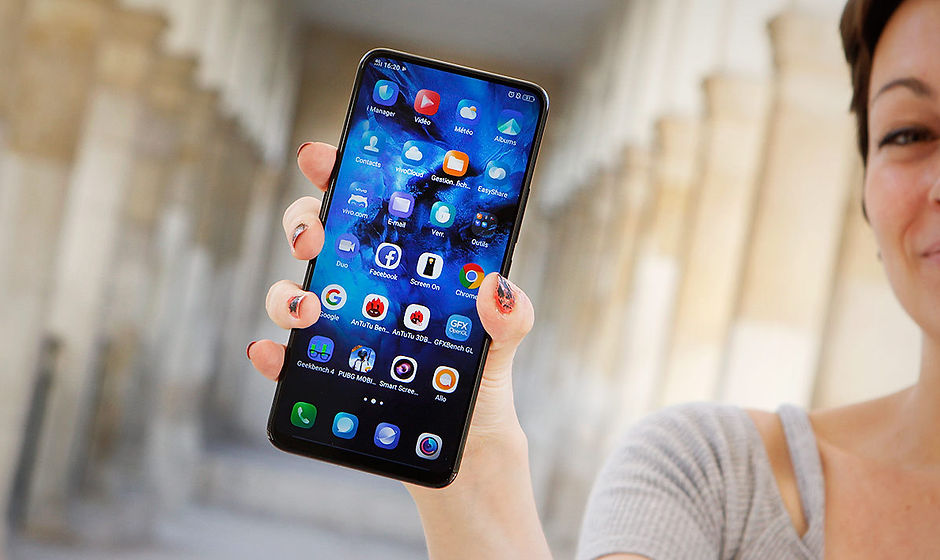
VIVO NEX
The rather unaffectionately named "slab" design has been, more or less, a staple of the smartphone realm for quite a few years now. Admittedly, it has become a little boring for many users. Even so, we can't, wholeheartedly refer to it as stale or stagnant. On the contrary. The standard bar phone from a few years back is vastly different from current models. Beyond curved panels and rounded edges, the general development path is pretty clear - all display and no bezels.
Overall, it has been a slow and steady grind, slimming down chins and side bezels systematically. However, on occasion, devices like the concept vivo APEX come along and with them, a major step forward in all-screen design. But there's more to it than meets the eye as well.
Specification
Body: Glass back; 162 x 77 x 8mm, 199g; Black, Red color schemes;
Display: 6.59" Super AMOLED display, FullHD+ 1080x2316 px, 19.3:9 ratio, 388ppi pixel density.
Rear camera: Dual: 12 MP, f/1.8 aperture, 1/2.5", 1.4µm; Dual Pixel PDAF, 4-axis OIS; 5 MP, f/2.4 aperture, dual-LED flash. 2160p@30fps video recording.
Front camera: Pop-up 8MP, f/2.0 aperture; fixed focus; 1080p/30fps video recording.
OS/Software: Android 8.1 Oreo; Funtouch OS 4.
Chipset: Qualcomm Snapdragon 845: 4x2.7 GHz Kryo 385 Gold & 4x1.7 GHz Kryo 385 Silver CPU, Adreno 630 GPU.
Memory: 8GB of RAM, 128/256GB of non-expandable storage;
Battery: 4,000 mAh Li-Po (sealed); 22.5 W charger in the box (likely Quick Charge 4+)
Connectivity: Dual SIM; LTE Cat16 1024/150 Mbps; USB 2.0, Type-C port; dual-band Wi-Fi a/b/g/n/ac; GPS, BDS, GNSS; Bluetooth 5.0; 3.5mm jack.
Misc: Under-display fingerprint reader; single speaker on the bottom; piezoelectric earpiece, Jovi digital assistant with dedicated button

GOOGLE PIXEL 2 XL
This model has a couple of differences over the smaller Pixel 2. For starters, the Pixel 2 XL has a larger 6-inch display with the 18:9 aspect ratio of display that has taken 2017 by storm. This, and the Pixel 2 XL gets a 21% larger battery than the 5-inch Pixel 2.Google offers the latest Qualcomm processor on both Pixels, along with its powerful HDR+ algorithm for taking photos. Combine these with Google's unparalleled Android experience, not to mention Google's unlimited photo storage with its official Photos app, and software updates directly from Google.
Specification
Body: Metal body with matte Premium Hybrid Coating; "3D" Gorilla Glass 5 on front; IP67 water resistance
Display: 6.0" POLED, 1,440 x 2880px resolution, 538ppi
Rear camera: 12.2MP, 1/2.6" sensor size with 1.4µm pixel size, f/1.8, OIS, dual LED flash and Google's HDR+ algorithm
Front camera: 8MP, 1/3.2" sensor size, f/2.4, 1.4µm pixel size
Video: 2160p @ 30fps, 1080p @30/60/120fps, 720@240fps; front camera:1080p @ 30fps
OS/Software: Android 8.0 Oreo with updates directly from Google
Chipset: 10nm Qualcomm Snapdragon 835 CPU - Octa-core (4x2.35 GHz Kryo & 4x1.9 GHz Kryo); Adreno 540 GPU; dedicated image processing chip to be enabled via OTA Android 8.1
Memory: 4GB of RAM; 64/128GB of internal storage (non-expandable)
Battery: 3,520 mAh Li-ion (sealed); USB-C Power Delivery 2.0 (5V @ 3A or 9V @ 2A with included 18W adapter)
Connectivity: nanoSIM; eSIM for Project Fi (US); Cat 15 LTE 800/75 Mbps; Bluetooth 5.0 LE, A2DP, aptx HD; Wi-Fi 802.11 a/b/g/n/ac, dual-band, Wi-Fi-Direct, DLNA; NFC; USB-C 3.1
Misc: Fingerprint scanner, dual stereo speakers, Always-on/Ambient display, Active Edge squeeze detection.

SAMSUNG GALAXY NOTE 8
Samsung is playing it safe with the feature set too. There are no mind-blowing innovations in the Note8. The phablet is predictably sized and equipped, sporting a familiar, if slightly tweaked design. Even the dual-camera setup is by no means revolutionary. On the contrary, perhaps it's even slightly overdue.
Specification
Body: Polished aluminum frame, Gorilla Glass 5 front and back; IP68 certified for water and dust resistance. Midnight Black, Orchid Grey, Deepsea Blue, Maple Gold color schemes.
Display: 6.3" Super AMOLED 'Infinity Display', 2,960x1440px resolution, 18.5:9 (2.06:1) aspect ratio, 522ppi; HDR 10 compliant (no Dolby Vision).
Rear camera: Primary 12MP, Type 1/2.55" sensor, f/1.7 aperture, 26mm equiv. focal length; Secondary 12MP, Type 1/3.4" sensor, f/2.4 aperture, 52mm equiv. focal length; dual pixel phase detection autofocus and OIS on both; 2x zoom. 2160p/30fps video recording.
Front camera: 8MP, f/1.7 aperture, autofocus; 1440p/30fps video recording.
OS/Software: Android 7.1.1 Nougat; Samsung Grace UX; Bixby virtual assistant; Smart Connect, Smart Connect Home
Chipsets: Qualcomm Snapdragon 835: octa-core CPU (4x2.35GHz Kryo 280 & 4x1.9GHz Kryo 280), Adreno 540 GPU. Exynos 8895: octa-core CPU (4x2nd-gen Mongoose 2.3GHz + 4xCortex-A53 1.7GHz), Mali-G71 GPU.
Memory: 6GB of RAM; 64GB of storage; microSD slot for cards up to 256GB, UFS cards support.
Battery: 3,300mAh Li-Po (sealed); Adaptive Fast Charging (same as S7/S8); QuickCharge 2.0 support; WPC (Qi)&PMA wireless charging.
Connectivity: Single-SIM, Dual-SIM available in certain markets; LTE-A, 4-Band/5-Band carrier aggregation, Cat.16/13 (1Gbps/150Mbps); USB Type-C (v3.1); Wi-Fi a/b/g/n/ac MU-MIMO; GPS, Beidou, Galileo; NFC; Bluetooth 5.0.
Misc: S-Pen stylus with 4096 pressure levels; fingerprint/iris/face recognition; single speaker on the bottom; 3.5mm jack; bundled AKG headphones; Dex dock compatibility allowing dekstop use mode on a bigger screen.
Now, we'll be the first to admit that this is a pretty strange place for the Note8 to be. We have no intention whatsoever of downplaying what is probably the most versatile smartphone today. At least on the surface though, there's nothing to be extremely excited about. Now, it might just be a blessing in disguise, letting us evaluate it from a power-user perspective, without worrying too much about the impression it makes or fails to make to the mass-user.